Operational intelligence for distributors

Know which
customers are slipping.

SCM Systems turns your order and stock data into a short list of exceptions: what changed, why it matters, and what to do next.

See how it works
Supply chain in two parts. Planning: demand planning and supply planning. Execution: supplier management, customer order management, and sales execution with CRM.

The problem

Your team already has the data. What it lacks is a short list of what needs attention this week, with the evidence and the next step attached.

Where it goes wrong

  1. 01

    Reports show everything and flag nothing

    Finding the five things that need attention this week still means digging through spreadsheets.

  2. 02

    Customers drift away quietly

    By the time the monthly numbers show a drop, the revenue is already gone and the follow-up is late.

  3. 03

    Problems surface after the customer asks

    A late SKU, a stock gap, or a supplier document that does not match the PO is found when it is already costing you.

Exception-first

Three questions on every screen.

01

What changed

Month and year sales against last year, customers ordering less, and SKUs that missed their usual reorder window.

02

Why it matters

Each exception comes with its evidence: the order pattern, the last order date, and the revenue at risk, ranked by exposure.

03

What to do next

Follow-ups for the sales team, a buy list for purchasing, and flagged documents for review, so nobody starts from a blank page.

Supplier documents

Documents are checked for you, too.

Supplier invoices and POs are read, matched to your SKUs, and compared against what you ordered. Only the mismatches reach a person. Scroll to follow one document through.

Inbox · orders@New
Acme Industrial SupplyInvoice 20931 · PO-7731
INV-20931.pdf2 pages · scanned

The system

One workspace for demand, supply, and operations.

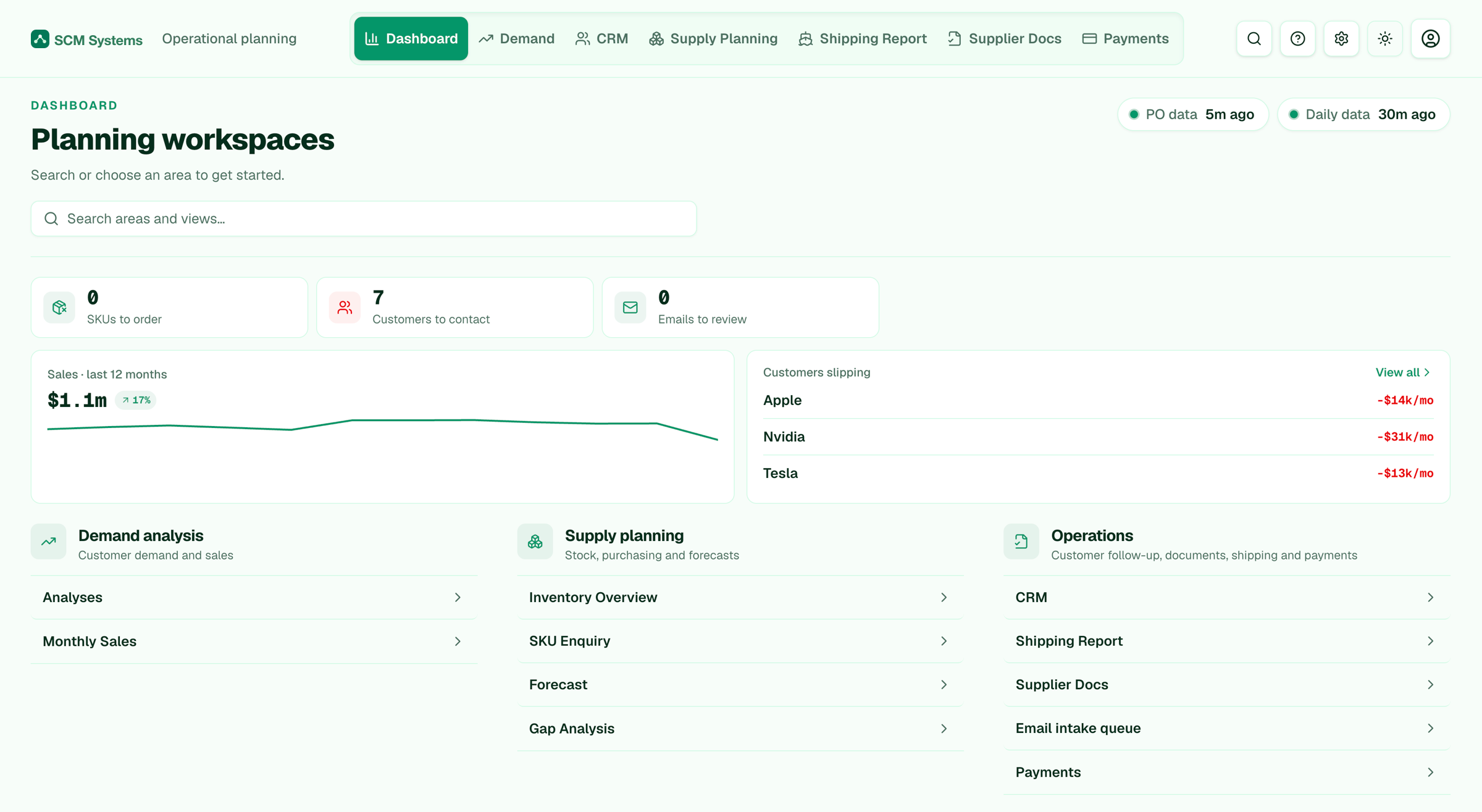
Start from a short list of what needs attention, then drill from the health panel to a customer to the SKU behind it.

The SCM Systems planning workspace: sales trend, customers slipping, and demand, supply, and operations areas

How the pilot works

Your data. Two weeks. Measured results.

  1. 01

    Connect your data

    A read-only feed from your ERP (or exports to start), plus one Outlook mailbox for supplier documents. Nothing is sent without approval.

  2. 02

    We model your customers and SKUs

    Each SKU is classed by how it is ordered, and each customer is scored for risk from your own order history.

  3. 03

    Review the exceptions together

    Your team sees the ranked customer queue, the SKU drilldowns, and the stock gaps, and tells us what is noise.

  4. 04

    Act on them

    Follow-ups, buy lists, and document checks flow into your team's day. One click to approve, edit, or reject.

What is inside

Demand, supply, and operations in one place.

Demand

Customer risk and sales

A ranked queue of customers by revenue exposure. Open one to see which SKUs are late, lost, reduced, or running above expected, with the order pattern that proves it.

Revenue at riskCustomer risk queueSKU drilldownMonthly sales
Supply

Stock, purchasing, and forecasts

See what to reorder and what is about to run short before a customer asks, built from the same order data.

Inventory overviewBuy listSKU enquiryForecastGap analysis
Operations

Documents, shipping, payments, follow-up

Supplier documents are matched against your purchase orders and only the mismatches reach a person. Shipments, payments, and customer follow-up sit alongside.

Supplier docsEmail intake queueShipping reportPaymentsCRM (in development)

How it judges risk

Every SKU is judged by how it is actually ordered.

A late order only matters if the customer normally orders on a cycle. SCM Systems classes each SKU from order frequency, so the exceptions are real ones.

Runners
Ordered steadily, so a missed order stands out fast.
Repeaters
Ordered on a regular cycle, with an expected reorder window.
Strangers
Ordered irregularly, so they are judged on their own history.
Newbies
Recently started, so they are watched without false alarms.

Is it a fit?

See your own exceptions.

  • You are a distributor, wholesaler, importer, or light manufacturer
  • You have a few years of order history in an ERP or exports
  • Sales, purchasing, and admin all work from the same data, in different spreadsheets
  • Supplier invoices and POs arrive by email, and someone checks them by eye

A 2-week pilot on your data and one mailbox, with a clear scope and price. Your team approves everything.

See how the pilot works